TerraFlow Mobile puts every locate reading on the map at the spot it was taken, with the depth, the method and the accuracy of the GPS fix attached.
It runs on the Radiodetection, Vivax-Metrotech or Rycom locator your crew already carries, and the GPS receiver they already own.
See what a locate record contains
A four-card row directly under the hero. Locating first and visually largest. Radiation and surface get their own cards so those buyers see their work named on the first screen.

One app for the work that has to be in the right place.
Utility locating Position, depth, method and GPS accuracy on every locate point. The sketch is mostly done before the truck leaves. On the Radiodetection, Vivax-Metrotech or Rycom locator your crew already carries.
Radiation surveys Gamma walkover surveys with a GNSS position on every reading, one a second, at the accuracy your receiver supports. Ludlum meters read directly, coverage you can show, and results in your GIS while the technician is still scanning. Running at Port Hope with WSP.
Surface and landfill Cut and fill against design while the machine is still on the surface. Height, slope and volume measured as the work happens, with the accuracy of every point recorded.
Pole mapping Every pole and attachment, measured with a laser rangefinder and GPS in one visit. Heights, clearances and spans in the same format on every pole, ready for make-ready engineering.
A closed ticket is asserted, not proven.
Paint fades in weeks. Flags get pulled. A phone photo has no coordinates you'd stake anything on.
So on most locates, the only record that the line was found is a photo of paint and the locator's word. The ticket shows the locate was requested and closed. It can't show the line was where the marks said.
Nobody audits that gap, because paper makes it invisible.
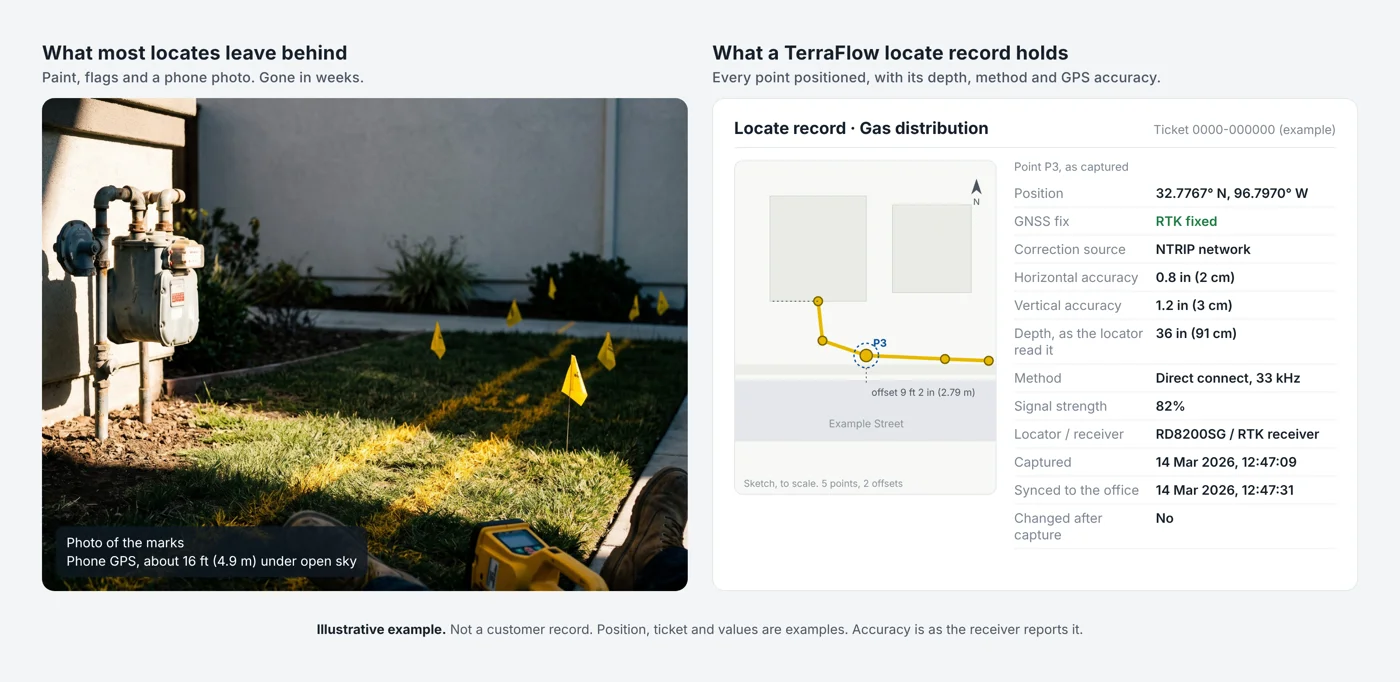
Illustrative example. On the left, what most locates leave behind: paint, flags and a phone photo. On the right, what a TerraFlow record holds for the same kind of locate: every point positioned, the depth and method recorded, and the GPS accuracy at the moment of capture.
Your tolerance zone is measured in inches. A phone's GPS is off by feet.
Tolerance zones are set by state law, commonly 18 inches (46 cm) either side of the mark and wider in some states (PHMSA state law summaries). GPS.gov puts a phone's GPS at about 16 feet (4.9 m) under open sky, and it's worse under trees (GPS.gov).
When the position error is bigger than the tolerance zone, you haven't recorded where the line is. You've recorded roughly which yard it's in.
With an RTK receiver, the error drops to something the manufacturer specifies at about half an inch to an inch and a quarter (1 to 3 cm). Now the record says where the line actually is. And every TerraFlow point stores how good its fix was, so nobody has to take the number on trust.
Not a pin on a map.
Position Every point at the accuracy your receiver delivers, with the fix type and correction source stored beside it.
Depth of cover The locator's depth reading, recorded exactly as the instrument reported it and tied to the point it was read at.
Utility type Classified as it's captured, in the same colour code your crews mark with.
The sketch Drawn to scale in the field. It's roughly 90% done by the time the locate is finished: the points, lines and depths are already there, so the locator just draws it in. No measuring wheel. No tape. Straight out to CAD and GIS.
Guild Electric cut locate completion time by 40 to 75%. The bigger the area, the more they saved.
The locate doesn't change. The paperwork does.
Your crew keeps the locator and GPS receiver they carry now. We set up your asset types, attributes and sketch conventions before anyone starts.
Training takes about an hour, and the help centre has every step written down. The app works with no signal and syncs as soon as it finds one.
Tickets keep arriving the way they do now. The sketch and the record build while the locate happens, so there's less to finish in the truck at the end of the day.
Start with one truck.
Most locate companies stay on paper for a good reason. Changing anything in the middle of the season costs a week nobody has.
So don't change anything. Put TerraFlow on one truck for a month, with the locator and GPS that crew already carries. They start on our standard locate workflows and locate the way they always have. At the end of the month, you put their records next to what that crew normally hands in.
If it isn't obviously better, you've spent a month on one truck and nothing else changed.
The loop closes while the locator is still on site.
TerraFlow works offline first. Maps, forms and data stay on the tablet. As soon as there's signal, the locate syncs to the office.
So the office can check a locate while the crew is still standing there. If something's missing, it gets fixed on site, not three weeks later when the marks are gone.
Fix it while the crew is still there, or explain it for the life of the claim.
We don't replace your ticket system. Tickets still come in the way they do now. TerraFlow adds the record the ticket was never built to hold.
Your contractors do the locates. You answer for them.
Today those records reach you as PDFs, photos, sketches and email attachments, in whatever format each contractor happens to use. When an auditor asks for every locate on a corridor over a date range, the scramble starts.
That's a format problem, and you don't need to buy software for a hundred contractors to fix it. You need a record standard.
We've written ours, field by field. Ask us for a copy at contact@terraflow.ca and put it in your contractor requirements, whether or not anyone uses our software.
PUC Services in Sault Ste. Marie works this way now, with RTK receivers and TerraFlow connected to ArcGIS Online (Esri Canada).
The record has to outlive the contractor, the crew and the software.
Locate records carry retention obligations measured in years. Crews turn over. Contracts change hands. Software gets bought and sold.
So ask any software vendor two questions. Who owns the company? And what happens to my archive if it's acquired or shut down?
We're owned by none of the hardware makers, ticket-system companies or one-call operators. We don't sell a ticket system, and we don't ask you to replace yours. And your data leaves in standard formats any day you want it.
You find out whether a vendor got this right when it's too late to change vendors.
Your data lives where your rules say.
Each client gets its own database in Microsoft Azure. Or install TerraFlow inside your own network: your servers, your database, your backups.
On-premises deployment · Data ownership
More than 100 locating and radiation survey companies use TerraFlow in the field every day.
PUC Services in Sault Ste. Marie deployed TerraFlow to connect its crews' RTK receivers to ArcGIS Online. Esri Canada reports PUC's positioning error fell from 10 to 16 feet (3 to 5 m) to about an inch (2.54 cm) (Esri Canada, March 2026). In October 2026 the Ontario Dig Authority gave PUC its Innovation in Dig Safety Award for integrating RTK positioning with its GIS (PUC, October 2026).
Customers include GTel, PVS Contractors, Hydro One and Bluewater Power.
WSP runs TerraFlow across the Port Hope Area Initiative, which Canadian Nuclear Laboratories calls one of Canada's largest environmental remediation projects. Read the case study